Thursday, November 30, 2006

Heart and Money, Part 3

On Wednesday Nov. 29, ABC's 20/20 aired an incredibly episode that surprised me and uplifted me. The news article really blew some myths out of the water. Below are some excerpts from two ABC news story that made up the broadcast.
Are Americans Cheap? Or Charitable? by John Stossel and Gena Binkley
Do you give? Or are you cheap? I keep hearing that "Americans are cheap."

"Yes," they say. Former President Carter recently said the rich states "don't give a damn" about people in poor countries. U2 singer Bono says, "It's the crumbs off our tables that we offer these countries."

Crumbs because many other countries, such as Norway, Portugal and Japan, give a larger share of their wealth to needy countries. The United States gave out $20 billion in foreign aid last year, but as a percentage of our wealth, we rank 21st out of the 22 major donor countries.

Actress Angelina Jolie is horrified by it. "It's disgusting. It really is disgusting," she said. "I think most American people, you know, really do think we give more. And I know that they would if they could understand how little they give and how much more we can afford to give, absolutely, without even noticing it."

But wait a second. … When talking aid, why just talk about what the government gives? America is anything but cheap.

Carol Adelman at the Hudson Institute has studied how much Americans give privately in foreign aid. She says it's a myth that Americans are stingy. Adelman published her findings in the institute's "Index of Global Philanthropy," which found that while the U.S. government gave about $20 billion in foreign aid in 2004, privately, Americans gave $24.2 billion.

After the tsunami two years ago, the U.S. government pledged approximately $900 million to relief efforts, but American individuals gave $2 billion in food, clothing and cash.

The fact that most of America's charitable gifts come from volunteers, not government, demonstrates that Americans are different from people in every other country. "No other country comes close," said Arthur Brooks, a professor of public administration at Syracuse University. Brooks studies charitable giving and has a new book, "Who Really Cares: America's Charity Divide."

"Americans per capita individually give about three and a half times more money per year, than the French per capita. … Seven times more than the Germans and 14 times more than the Italians."

"The fact is, that Americans give on a different scale than anybody else in the world."

Thank goodness we do because charity does it better. I notice the difference on my way to work because in my neighborhood, the men in blue — that's what they call themselves — clean the streets.

They're not volunteers. It turns out that they're former street people. … Ex-alcoholics and drug addicts. The Doe Fund, a private charity, puts them to work while they try to teach them to be responsible and to stay clean. One year after entering the program, most of the men in blue are drug-free and employed. That's twice the success rate of other shelters in the city.

Regardless of what our government does, Americans are anything but cheap. Americans gave $260 billion away in charity last year — that's about $900 per person.

Who Gives and Who Doesn't? by John Stossel and Kristina Kendall
But just who is doing the giving? Three quarters of American families donate to charity, giving $1,800 each, on average. Of course, if three quarters give, that means that one quarter don't give at all. So what distinguishes those who give from those who don't?

We assume the rich give more than the middle class, the middle class more than the poor. I've heard liberals care more about the less fortunate, so we assume they give more than conservatives do. Are these assumptions truth, or myth?

It turns out that this idea that liberals give more…is a myth. Arthur Brooks, the author of "Who Really Cares," says that "when you look at the data, it turns out the conservatives give about 30 percent more." He adds, "And incidentally, conservative-headed families make slightly less money."

And he says the differences in giving goes beyond money, pointing out that conservatives are 18 percent more likely to donate blood. He says this difference is not about politics, but about the different way conservatives and liberals view government.

"You find that people who believe it's the government's job to make incomes more equal, are far less likely to give their money away," Brooks says. In fact, people who disagree with the statement, "The government has a basic responsibility to take care of the people who can't take care of themselves," are 27 percent more likely to give to charity.

Rich vs. Poor
The second myth is that the people with the most money are the most generous. But while the rich do give more in overall dollars, according to the Social Capital Community Benchmark Survey, people at the lower end of the income scale give almost 30 percent more of their income.

Many researchers told us lower income people give more because they think they are more likely to need charity or know someone who needs charity.

Workers at the meat packing plant where Lau works make on average around $35,000, yet the Sioux Falls United Way says it gets more contributions of over $500 from employees here than anywhere else.

And what about the middle class? Well, while middle-income Americans are generous compared to people in other countries, compared to the rich and the working poor, they give less. "The two most generous groups in America are the rich and the working poor," says Brooks. "The middle class give the least."

The Church Connection
Finally, the single biggest predictor of whether someone will be charitable is their religious participation.

Religious people are more likely to give to charity, and when they give, they give more money: four times as much. And Arthur Brooks told me that giving goes beyond their own religious organization: "Actually, the truth is that they're giving to more than their churches," he says. "The religious Americans are more likely to give to every kind of cause and charity, including explicitly non-religious charities."


The article describes a test in San Franscisco and Sioux Falls. The article ends teasing you to watch the show to see how the test turned out. Well, Sioux Falls blew away San Francisco in charitable giving.

There some really good details and anecdotes in the articles, I hope you read them. I was pleasantly surprised and my spirit boosted.

What questions and comments do these articles raise from you dear readers?

Dr. Lee Camp Injustice

I plan on cancelling my subscription to The Tennessean today. I am completely disgusted with how they have just dropped the whole issue like it never happened once their grievious error was revealed.

Below is an email letter that sent to the Tennessean reporter who misquoted Lee Camp badly in the Nov. 29 artcle, Christians must 'let go' some beliefs for sake of peace, theologian says. I copied several editors at the Tennessean as well. This is a link to Lee's rebuttal in today's Tennessean.

When I read your article of Wed. 11/29/2006 quoting Lee Camp, I was aghast knowing that all hell was going to break loose on Dr. Camp. I count Lee as a friend, a mentor, and I feel I understand his beliefs well.

Your isolated quotes were a severe misrepresentation of Dr. Camp's beliefs and his actual statements at the conference. A wise woman counseled me "not to ascribe to malevolence what may be ascribed to ignorance." However, your article had the appearance of sensationalism rather than just bad reporting.

I feel the manner in which you represented Dr. Camp was irresponsible journalism. It is also part of a growing trend of bad reporting and sensationalism I have witnessed in the Tennessean. There seems to be an eroding concern for contextual accuracy and more concern on creating controversy in order to make money. Unfortunately, the article may have done just that. The Tennessean management may be ecstatic over the firestorm.

This type of reporting only undermines your readers' trust. I am very skeptical of anything I read in the paper based on the discrepancies between what was reported and of which I had personal knowledge involving several stories over the years. Don't you think anyone you try to interview from this point on will be wary of your methods and intentions? Does this not make your job more difficult?

Although the Tennessean allowed Dr. Camp to reply, it does not undo the damaging spirit of your article nor the change the method of reporting.

I am a Nashville native and via my parents' subscriptions and my own subscription, I have been reading the Tennessean for most of my 44 years. This may be the straw that breaks the camel's back. I am seriously considering dropping my subscription.

I believe the Tennessean and yourself owe a public apology to Dr. Camp and to Lipscomb University--on the front page. Allowing Dr. Camp a rebuttal is not an apology for irresponsible journalism.

Monday, November 27, 2006

Discipleship v. Santa Claus

Children have an incredible knack of getting to the heart of a matter via their innocence and naivete. A recent exchange between my wife and our 6 year old daughter, who has a sweet, giving heart, provided a stark example of this.

We buy few toys for our daughter, but being the only young child on both sides of the family, birthday and holidays amass more than she can use despite our exhortations to relatives to go extremely light. My wife was cleaning out toys, games, etc. that are cluttering up our house and that our daughter rarely plays with. The idea was to give them away. As is natural with a child, Maria did not want to part with things once she saw them, not selfishly, but they suddenly held new interest. Below is a paraphrase of the interchange.

But momma, I don't want to give that away (repeat multiple times).

Well honey, you don't use these very often and you have more than you need. We can give these to poor children who won't get much, if anything, for Christmas.

You mean Santa Claus doesn't visit poor children? (First, sobering moment!)

Well...honey...er...yes...but they might not get as much as you do. (Hagrid quote at this point: "Ooops, I shouldna oughta sad dat)

But why? Santa brings me four or five things. Do they only get one? (Second sobering moment)

Please bear in mind that my wife was busy in the task, was not attempting to analyze nuance of any of her words, nor attempting to anticipate the probing mind of a young child. She did not see the turn of conversation coming.

There are many explanations a parent could concoct, especially in hindsight. The best of which might be to say Santa and Christ want us to have the their spirit and help Santa at Christmas. However, it does not matter what explanation you use, it does not address the underlying issue.

The young child has recognized an inequality created by man that cannot be reconciled with man's benevolent icons. And the result is a loss of innocence. I was very tempted to tell her the truth about Christmas and Santa Claus, running the risk that she become a pariah among her classmates and the children's ministry as she blasts the unholy news.

But this does not solve the problem. When she discovers that this is not a Santa Claus issue, her immediate leap will be to ask why does God let poor people suffer.

The interchange shows the dilemmas Christians create by combining secular idealism and Christianity (the spirit of Santa Claus, celebration of Christmas combined with Christ). We create paradoxes, as if our faith did not have enough to deal with.

It also is an inevitable occurance of having the innocence of a child who loves God slowly chipped away as they confront a broken world. This is one of the toughest challenges parents face, and we make it harder on ourselves with the idealic myths we have created and perpetuate.

Any insight from my readers is greatly appreciated.

Thursday, November 16, 2006

Heart and Money, Part 1 & 2

Part 2: The following excerpt is from an article in Saturday's Tennessean and originally from the Nov. 18, 2006 Los Angeles Times entitled "Study finds what money can buy you: a sting, selfish outlook" by Karen Kaplan. The article is directly related to our discussion. Independent, non-religion based research is proving what God and Christ have been trying to tell us from day one.
A team of psychologists has discovered why money can't buy happiness. Pictures of dollar bills, fantasies of wealth and even wads of Monopoly money arouse feelings of self-sufficiency that result in selfish and often antisocial behavior, according to a study published Friday in the journal Science.

All it took to discourage college students from contributing to a University Student Fund were 15 short phrases such as "a high-paying salary." Those primed by money-related phrases donated an average of 77 cents, compared with $1.34 for students exposed to neutral phrases like "it is cold outside."

"The mere presence of money changes people," said Kathleen Vohs, a professor of marketing at the University of Minnesota and lead author of the study. [Researchers] theorized that even subtle reminders of money would inspire people to be self-reliant — and to expect such behavior from others. A series of nine experiments confirmed their hypothesis. For example, students who played Monopoly and then were asked to envision a future with great wealth picked up fewer dropped pencils for a fellow student than those who were asked to contemplate a hand-to-mouth existence.

"Money changes people's motivations," said coauthor Nicole Mead, a psychology graduate student at Florida State University. "They are less focused on other people. In this sense, money can be a barrier to social intimacy."

Could it actually be that scripture is indeed a little bit more than man-made literature? Uummm.

Part 1:
Nov 17: I have posted an addendum to for clarification purposes. See the end.

I have been dealing with a few issues as a member of our church's leadership that have sparked the thoughts I share today.


Do not store up for yourselves treasures on earth, where moth and rust destroy, and where thieves break in and steal. But store up for yourselves treasures in heaven, where moth and rust do not destroy, and where thieves do not break in and steal. – Matthew 6:19-20.

I believe many Christians today misinterpret Matthew 6:19-20 to mean we are to be responsible stewards our fiscal and physical resources. This is true in its simplest form. Taken a little further, it is a warning about riches. My study Bible has this comment: “The dangers of riches are often mentioned in the NT, but nowhere are they condemned in and of themselves. What Jesus condemns here is greed and hoarding of money.”

Even my study Bible provides the hint of an escape clause concerning material possessions. The ever-present, human qualifiers of “but” and “however” that allows us to skirt the hard issues about which Jesus spoke.

I feel the standard interpretations completely ignore verse 21.


For where your treasure is, there your heart will be also.

I am not a scholar of scripture and language, but it seems to me that Matthew 6:19-24 is speaking about heart matters not about God's material resources bestowed upon us. If our hearts are with God, then where material wealth ends are up will take care of itself. We will put it where He needs it.


[22]The eye is the lamp of the body. If your eyes are good, your whole body will be full of light. [23]But if your eyes are bad, your whole body will be full of darkness. If then the light within you is darkness, how great is that darkness!
[24]No one can serve two masters. Either he will hate the one and love the other, or he will be devoted to the one and despise the other. You cannot serve both God and Money.

Interestingly, my Bible capitalizes the word Money (I look forward to your comments on this JMG). I feel strongly that materialism is one of the greatest threats against today's Christian. Too many of us are unknowingly practicing idolatry. If we love each other, then we will hold each other accountable on this issue, because the effect is not on church budgets, it is on the individual soul.

A common sentiment when you get into this area is, "I really resent church leadership wrapping money and the heart together just to increase contributions."

I do not think we should be ashamed of wrapping of money and heart together. Jesus did and he showed that the two have profound impact on each other. This is not about increasing collections; it is about challenging each other on where our hearts truly dwell. This is a tough question, which frankly many are afraid to address head-on because of what the question might reveal.

I know these are sensitive, complex, and serious issues. That is exactly what Christianity is: sensitive, complex, and ultimately serious.

Nov 17 addendum:
My beef is that we are not meeting budget with contributions will the median wealth in our congregations is astounding. My concern is that if everyone tithed, churches would have so much money to put into service it would not be funny. Just everyone giving 5% would likely blow church budgets right out of the water.

At the same time, there are areas of church spending that I feel need major attitude shifts. I want church leaderships (me included, being part of a leadership) to look very hard at their spending weeding out unnecessary expenses, self-serving expenses, and finding efficiences where ever we can.

But, the purpose is not to reduce budgets. The purpose would be to support agressive budgets in which the majority of dollars went directly to Kingdom work: ministries to the hurting in our congregation; ministries to strengthen and edify our spiritual being for Kingdom service; and most importantly, major external service (not evangelizing) to the world--both the local community and missions.

If churches do not do the above, what is our purpose? Where do our hearts truly lie? We must let the churches' external actions evangelize, not our words to our little social clubs inside our elaborate walls.

What are your thoughts dear readers?

Wednesday, November 08, 2006

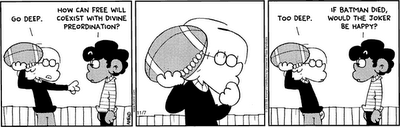
GO DEEP

I am posting this for JMG's enjoyment, and hopefully the rest of you. Check out her post for this week to understand the reference.


This one is JMG's extra credit for doing the assignment ahead of schedule and being verbo....I mean exceeding the 300 word minimum.

Monday, October 30, 2006

Kingdom Come & Vote For Me

Two simple posts for your enjoyment this week. If they spark any thoughts, please share.


*****************************************
VOTE FOR ME
by Robert Lamm

Vote for me, vote for me
I want the nomination for the Presidency
Vote for me, vote for me
If I am elected, this is how it will be.

I'll cut your tax in half
I'll make the Russians laugh
I'll feed the hungry people everywhere.
I'll bring the railroads back
New trains and new track
From Waikiki to old Delaware.

Vote for me, vote for me
I want the nomination for the Presidency
Vote for me, vote for me
If I am elected, this is how it will be.

I'll give Detroit one year
New cars that run on beer
Or anything except gasoline.
I'm looking to the sun
More power for everyone
And the cleanest sky that you've ever seen.

I'm not going to kid you, there's a lot to do
Little can I promise, it's really up to you
But if we all work together
And I think we can
And if you want some new ideas
Then I'm your man.

Vote for me, vote for me
I want the nomination for the Presidency
Vote for me, vote for me
If I am elected, this is how it will be.

I'll work for global peace
And the sweet release
Of the love and human kindness in us all.
I would give all I've got
You just give me a shot
Somehow, I know that I can win the fall.
********************************************

Some things never seem to change. The above song is from Chicago 11, Sept. 1977.

Tuesday, October 24, 2006

What Life Legacy Would I Want?

FYI: New Post at MD

Amongst several blogs including this one (Mere Discipleship Blog, Tangled Weblog, Jettybetty, Phil's, Amy's), we have had continued discussion about the meaning of real discipleship and challenging ourselves on what that means in our lives. The excerpts from the article below illuminate clearly the attributes of a modern day disciple.

Excerpts from Party puts Cokesbury on mission for charity by Kevin Cowan Oct. 24, 2006, www.knoxnews.com
A lavish party and the work of a deceased church member have inspired Cokesbury United Methodist Church. The West Knoxville church has set a goal to raise $100,000 for the Red Bird Mission in Beverly, Ky. The organization provides spiritual, educational, health and community outreach ministries to the needy in a three-county region in the Appalachians.

Dr. G. Steven Sallee, senior pastor, read the Oct. 2 News Sentinel article "My Super Sweet 15," which chronicled an over-the-top birthday party thrown for a Farragut teen. The bash was inspired by MTV's series "My Super Sweet 16," which goes behind the scenes of six-figure parties for wealthy teens.

"I came home from church and I read that story," Sallee said. "At 2 o'clock that same afternoon, I went back to church to conduct a funeral for a member." The member was Rachel Noble, 81, of Knoxville. She and her husband, Walter Noble, "responded to a need in Red Bird," Sallee said, "and ministered to some of the poorest people in Appalachia for 35 years."

According to government statistics, Beverly's Clay County is the poorest county in Kentucky, with a per-capita income of $9,626. About 40% of the county's residents live below the poverty line. Also, 50% of Clay County residents older than 25 are not high school graduates.

At Red Bird, Rachel Noble was a nurse, Sallee said, and her husband carried "coal to the school and worked at some of the churches." It bothered the pastor that Rachel Noble "spent 35 years helping others and that it was going to be unnoticed," he said, "and that this little 15-year-old girl had gotten all of this notoriety for all of this money spent for a birthday party."

So Sallee came up with the idea to begin a series of sermons, "The Cure for the Common Life." The first cure introduced to the congregation was "finding a cause." As part of the sermon delivered Oct. 8, Sallee retold the story of the birthday party and shared the story of Rachel Noble's life.

"Spontaneously in the sermon, I said I think we should raise $100,000 to take to the Red Bird Mission in Rachel Noble's name," Sallee recalled. "As soon as I announced it, the entire congregation started applauding." As he sang the service's final song, "People started coming down the aisle putting checks in my pockets," Sallee said. "I reached into my pockets and there was about $12,000 or $13,000 in checks."

In the days after the message, money has continued to be donated, even by those who may have needed help themselves. "There was this woman dressed shabbily," Sallee remembered. "She said, 'That sermon has changed the way I look at life. I can't afford it, but I want you have this.' It was a check for $100."

Cokesbury is about at the $46,000 mark, Sallee said Monday. The pastor hopes to reach the goal by Oct.31 and present the check to Red Bird Nov. 5 during a service at the church. If more than $100,000 is raised, Sallee said Cokesbury wants to donate the excess to Second Harvest, a local food bank.

To make a donation, mail checks (payable to Cokesbury for Red Bird Mission) to Cokesbury United Methodist Church, 9908 Kingston Pike, Knoxville, TN 37922. To find out more about Red Bird Mission, go to www.rbmission.org.

Now that is the legacy of a disciple. As I was reading the article, I realized that Mrs. Noble was the mother of one of my bosses. The effort will be getting a check from me.

Monday, October 09, 2006

Freedom and Where Do You Go to Get Away

Below are the lyrics to three songs from King's X most recent CD Ogre Tones, two of which I used as a discussion tool in our college life group last night. I post the lyrics here to see what response they generate from the blog world. The two songs I used in life group were Freedom and Get Away. If the songs spur some thoughts, please post them.

Alone
No one should be made to feel...ALONE!

No one should be made to feel rejected, and to feel the pain
No one should be made to feel unwanted, and to feel the hate
Sticks and stones, breaking bones
Names and words they hurt you...effecting everything

No one should be made to feel alone...nobody...nobody should
No one should be made to feel alone...alone...alone

No one should be made to feel their heart break, and to feel unloved
No one should be made to feel they're ugly, and to feel ashamed
Sticks and stones, breaking bones
Names and words they hurt you...effecting everything

No one should be made to feel alone...nobody...nobody should
No one should be made to feel alone...alone...to feel alone
No one should be made to feel alone...nobody...nobody should
No one should be made to feel alone...alone...to feel alone

Alone...Alone...Alone

Freedom
Freedom, to have two mothers and all be men
Freedom, to terminate Jay Phebus if he don't fit in
Freedom, to kiss my brother right on the lips
Freedom, to make my own concoction and take a sip
What a trip.... blame it all on God

Freedom... Freedom... Freedom... Freedom...

Freedom, to pay for a killer to have TV
Freedom, to get elected and set my own salary
Freedom, to go out and join the KKK
Freedom, to get in trouble for everything that I say
What a day.... blame it all on God

Freedom... Freedom... Freedom... Freedom...

Freedom, to scam everybody and make a buck
Freedom, to get your credit card number and press my luck
Freedom, cut down the forest, make new disease
Freedom, and throw everything we got into the seas!
And would you please... blame it all on God, we can blame it on God!

Freedom... Freedom... Freedom... Freedom...


Get Away
Hey God, I watched the news tonight, why are your people so f&%$ing mean?
Hey God, that kid was locked up for 3 years, why do the innocent suffer?

Where do you go....to get away....away

Hey God, they say your perfect and in control, and I am falling apart
Hey God, the god of so many names, but who can I blame, what the hell are you thinking

Where do you go...to get away...away

We're standing here and we're couting our fears ... Abraham
Live in a desert, there's nothing there ... Abraham

Where do you go...to get away...away
************************************

What feelings and thoughts do these lyrics arise in you?

Thursday, September 28, 2006

Would I? Could I? Hard Kingdom Questions

Ever since I read Lee Camp's Mere Discipleship, I have been awakened to a better understanding of the Gospel of Christ and it has raised to the surface many concerns in my heart about myself that probably lurk in all of our hearts if we are honest. Recently, JMG posted some questions and thoughts in a post at Musings From the Chariot that forced me to articulate my internal wrestlings. I post my self concern because I need input? I need to hear some of your thoughts on the matter.

Attempting to live the life Jesus preached, to do what the disciples did, would turn the majority of Christians' lives completely upside down--immediately. I am scared that I am not getting the true message and not truly doing what Jesus called me to do as a disciple. Yet I don't quit my job and go out to serve the poor or be a missionary anywhere. I don't radically change my lifestyle, drop my nets, and live a life of direct service to the Kingdom.

This realization is very hard on me. I am concerned but I don't change my life. I don't mean I am not constantly becoming a better person because I do see myself progressing to better discipleship, but I have not made any radical changes and frankly I am afraid too. I am a spiritual coward.

I think what bothers me the most is not whether I try to serve the Kingdom through my current life or give it all up and dedicate myself to some mission. What bothers me is when I ask myself, "would I do it? Am I willing to do it--give it all up?"

God may not ask me to serve in such a fashion? He may leave it up to me to decide. He may want me to serve through my job and my career. I certainly have talents in those areas. But it is the question and contemplation on the answer that hurts. Am I selfless enough to sacrifice all for my Savior and His Kingdom? I am supposed to be willing. But would I really do it?

I firmly believe, know in my heart, that I could sacrifice my life to not denounce God and Christ as Lord. But would I completely give up my way of life to live a hard one? Do I have that much courage? Even further, would I do it voluntarily, without the Lord directing me to do so? Do I have that much conviction?

I am not confident of my answer to these last questions. Based on imperical data of my life, the answer is no. If the answer is no, am I really a disciple?

Does anyone else feel this way? What are your thoughts on the matter? I am truly troubled by this topic.

Monday, September 18, 2006

Friends

My job has become very time demanding and I have many commitments outside that are taking the place of blog time. I miss being able to write, but I have to make choices. I apologize for the infrequency, or some may wish to thank me for it.

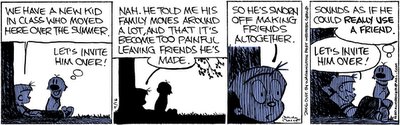
So today a quick post. Red and Rover is my favorite comic strip. I love the sentiment, the feelings it stirs, the positive and uplifting messages. This was a recent strip that I think speaks volumes. I hope you like it.


Anyone think this might have some application in our church communities?